How to Put a Baby in a Bilirubin Blanket
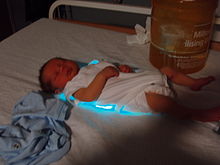
A baby being treated for jaundice with a BiliBlanket
A biliblanket is a portable phototherapy device used to treat neonatal jaundice (hyperbilirubinemia).[1] BiliBlanket is a trademark of Full general Electrical'due south Datex-Ohmeda subsidiary, but its name has get the generic, colloquial term for a range of similar products and the term used in the medical professions. The proper name "biliblanket" combines the words bilirubin and blanket. The baby is placed in directly contact with the pad.[ii] This device is also known as domicile phototherapy system, bilirubin blanket, or bidirectional fiber-optic phototherapy coating.[ citation needed ]
Different types of phototherapy for jaundice involve a blue lite of varying types of calorie-free, wavelengths, and degrees of irradiance. The light waves promote breakup of bilirubin and allow information technology to be eliminated.[3] Compared to standard forms of phototherapy, a biliblanket utilizes a fiberoptic arrangement, allowing them to be used at domicile.[ commendation needed ] The biliblanket organization consists of three components: an illuminator, fiberoptic pad, and disposable pad encompass.[ citation needed ] The fiberoptic pad is used to transport bluish or white lite from the lite source, the illuminator, directly onto the babe's peel.[4]
Neonatal jaundice [edit]
Jaundice (Hyperbilirubinemia) is non uncommon in newborn babies and presents itself as yellow discoloration of the pare and whites of the eyes (sclera). Jaundice occurs in roughly 60% to 84% of infants.[ citation needed ] This condition also causes babies to appear sick, feel difficulty waking up, make loftier-pitch cries, or not be able to exist fed or gain weight.[5] Bilirubin is an orangish yellow bile pigment that is produced as a byproduct of hemoglobin as red claret cells break down (hemolysis). Bilirubin is then metabolized in the liver, recycled, and excreted in the bowel movements. When a babe has jaundice or hyperbilirubinemia, this tin indicate that the baby'due south body is producing excess bilirubin or that the liver is besides immature to be able to eliminate bilirubin fast plenty.[6] Feeding, in particular breastfeeding, the babe often in the kickoff few days of birth can help lower the chances of developing jaundice, since the baby will laissez passer more stool and the milk provides energy to the liver to allow metabolism of bilirubin. Uncontrolled levels of bilirubin can be harmful to the baby.[seven] Most neonatal jaundice shows during the get-go week later nascency. All the same, when bilirubin levels go exceedingly high, the substance may move out of the blood, cantankerous the blood brain barrier, and collect in brain tissue, dissentious the baby's brain cells, a condition known as astute bilirubin encephalopathy.[viii] If acute bilirubin encephalopathy is not addressed promptly, Kernicterus syndrome tin can develop and cause permanent brain damage.[nine] In rare situations, a baby may experience seizures, deafness, cognitive palsy or mental retardation.[three] Jaundice tin can exist prevented and treated in the majority of cases. Jaundice is more dangerous in certain cases such as babies who are born prematurely (earlier 37 weeks of gestation), babies who are underweight (less than 2500 grams at birth), babies who are going through an infection, babies who experienced a difficult commitment or have bruises (since they are replacing and breaking down more than red blood cells at a higher charge per unit) and babies who have a blood group that is non uniform with their mothers.[seven]
Phototherapy machinery [edit]
Jaundice in some babies can disappear within one to two weeks without treatment; even so for babies with more astringent jaundice, treatment is required. Traditional phototherapy devices include blue LEDs, halogen white light, and fluorescent tubes. A biliblanket is a phototherapy habitation treatment that consists of a portable illuminator and fiber-optic pad. Information technology uses a pad of woven fibers to transfer light to a baby in order to treat neonatal jaundice (hyperbilirubimia). It uses visible calorie-free to transform bilirubin into a more h2o-soluble form that allows information technology to dissolve easily in water and be eliminated. This therapy lowers the serum bilirubin level. The baby is placed on the fiber-optic pad, which has a disposable embrace in direct contact with the baby'due south skin.[ citation needed ] This fiber-optic pad exposes the skin to light, and bilirubin is eliminated when low-cal is absorbed.[two] The biliblanket releases waves of blue or white light, when these are absorbed in the skin, bilirubin breaks downward and is eliminated from the babe's blood stream.[ commendation needed ]
This lowers the yellowing effect in the baby'south eyes and skin.[1] Afterwards, blood needs to be tested to observe bilirubin levels and determine whether the biliblanket is still needed. Majority of babies that need a biliblanket use it for several days, but it depends on each baby'south condition. Fifty-fifty though a biliblanket may cause loose stools and skin rashes, information technology is considered safe for the most role. This device is mostly used for ii to 3 days only. In severe situations, intravenous fluids may be needed to be given to the patient.
Phototherapy uses photons of free energy that are infused and captivated by bilirubin located in superficial capillaries and subcutaneous tissues and interstitial spaces of the skin. Photochemical reactions then transform bilirubin into nontoxic isomers that are more polar, h2o-soluble and therefore, can exist excreted without being further metabolized by the liver. Urinary and gastrointestinal emptying remain important to the process of reducing the bilirubin load.[vi]
Proper use [edit]
The biliblanket setup consists of the calorie-free generator, termed the light box, the fibre-optic cable through which the low-cal is carried, and the fiberoptic pad, which is a 25cmx13cm (x"x5") pad that is attached to the baby. The light generator stores the source of light, which is a halogen bulb. The fiber-optic cablevision connects the calorie-free generator to the fiberoptic pad, which contains fiberoptic fibers and usually has a disposable encompass.[ citation needed ]
It is of import to brand certain that the light-source car is placed on a flat, level, hard surface such as a tabular array or nightstand to ensure proper ventilation. A disposable comprehend is placed onto the light pad and should be inverse if the cover becomes soiled. For effective therapy, the infant'due south skin should exist directly exposed to the light pad every bit much as possible. The light pad should exist on at all times except during baths. The light pad is usually placed on the undressed babe's back with a diaper on. Clothing may exist worn, but the clothing should exist placed over the lite pad, and the light pad should still be in directly contact with the baby's skin. The calorie-free pad should never be placed on the baby'southward head.[ii] The baby can sleep, eat, or be held while the light pad is on.
The biliblanket is safe and can be used for 24 hours a day every bit long as therapy is required. Nonetheless, the duration of phototherapy volition vary from individual to private based on the baby'south current condition and disease state. It will as well depend on the doctor's clinical sentence.[10]
Blood tests may exist required daily during phototherapy to assess the bilirubin levels and decide if normal levels have been reached and whether or not phototherapy can be stopped. Once the bilirubin levels are normal, the baby'due south peel will return to its normal color.[two]
Side effects [edit]
1 mutual side consequence that is experienced by babies who are receiving phototherapy treatment is more frequent and loose stools. The colour of these stools are unremarkably a greenish color; nevertheless, this is normal because that is the way bilirubin is removed from the torso. Every bit bilirubin levels return to normal and phototherapy is no longer needed, the frequency of bowel movements and the colour of the stools volition return to normal.[iii]
Short-term [edit]
- Skin lesions
- Diarrhea due to thermal and hydroelectrolytic abnormalities
- Statuary baby syndrome (grayness and brown pigmentation of the pare in infants with cholestasis)[11]
- Hematological changes
- Paralytic ileus
[3]
Long-term [edit]
- Neoplasms
- Pare lesions
- Café au lait spots
- Allergic diseases (allergic asthma, rhinitis, and conjunctivitis)
Other side effects of phototherapy include effects on circadian cycle genes, patent ductus arteriosus, and possible retinal damage if the eyes are exposed to abiding phototherapy.[3]
Advantages [edit]
Unlike conventional forms of phototherapy, which require eye protection, the infant does non demand to have center protection when using a biliblanket. Another reward of the biliblanket is that it tin be used at home. In some cases, if the baby's condition is not too severe, the parents will be given a biliblanket to ready up and use at home. This provides a more than comfortable and user-friendly setting since the parents and infant do non have to stay in the hospital. Other advantages of the biliblanket are that it tin be easily transported, can be used when the infant is sleeping, eating, and or being held, and promotes a relationship between parents and infants since they practice not need to be separated during treatment.[ citation needed ]
Disadvantages [edit]
From a review, fibreoptic phototherapy was more effective at lowering serum biliruben than no treatment simply less effective than conventional phototherapy. However, a combination of fibreoptic and conventional phototherapy was more effective than conventional phototherapy lonely.[x]
History [edit]
In 1956, Sister Ward, a nurse at Rochford General Hospital in Essex, England, discovered that a jaundiced baby's body had regained its normal pare color later exposure to the sun. One small region, which had not been exposed to the sun, remained xanthous in color. This discovery, along with findings that blood tubes exposed to the sunday showed a decrease in bilirubin concentrations, collection inquiry and development of the first phototherapy device for treatment of neonatal jaundice.[6]
Phototherapy has been used to treat neonatal jaundice since the early 1970's. The conventional form of phototherapy has been performed in the hospital for more than xxx years and requires the presence of multiple overhead light sources, such as element of group vii or fluorescent lamps, shining directly on the baby.[ commendation needed ] With advances in technology, novel forms of phototherapy emerged using optical fibers and a lite source. Clinical testing for fiberoptic phototherapy devices began in 1988.[x]
References [edit]
- ^ a b Mims T. "Biliblankets". Aeroflow Healthcare . Retrieved 2020-07-30 .
- ^ a b c d "Your Infant, Jaundice and Phototherapy". www.med.umich.edu . Retrieved 2020-07-30 .
- ^ a b c d e Faulhaber FR, Procianoy RS, Silveira RC (Feb 2019). "Side Effects of Phototherapy on Neonates". American Journal of Perinatology. 36 (three): 252–257. doi:ten.1055/s-0038-1667379. PMID 30081405.
- ^ Chang YS, Hwang JH, Kwon HN, Choi CW, Ko SY, Park WS, et al. (February 2005). "In vitro and in vivo efficacy of new blue light emitting diode phototherapy compared to conventional element of group vii quartz phototherapy for neonatal jaundice". Journal of Korean Medical Science. twenty (one): 61–iv. doi:10.3346/jkms.2005.20.1.61. PMC2808577. PMID 15716604.
- ^ "Newborn Jaundice: Causes, Symptoms, Treatment, and Prevention". Healthline. 2017-07-26. Retrieved 2020-07-31 .
- ^ a b c Stokowski LA (October 2011). "Fundamentals of phototherapy for neonatal jaundice". Advances in Neonatal Intendance. 11 (5 Suppl): S10-21. doi:10.1097/ANC.0b013e31822ee62c. PMID 22123449. S2CID 23883586.
- ^ a b "Jaundice in newborns". Paediatrics & Child Health. 12 (v): 409–20. May 2007. doi:10.1093/pch/12.5.409. PMC2528723. PMID 19030401.
- ^ "Bilirubin encephalopathy: MedlinePlus Medical Encyclopedia". medlineplus.gov . Retrieved 2020-07-31 .
- ^ "Kernicterus". NORD (National Organization for Rare Disorders) . Retrieved 2020-07-31 .
- ^ a b c Mills JF, Tudehope D, et al. (Cochrane Neonatal Group) (2001). "Fibreoptic phototherapy for neonatal jaundice". The Cochrane Database of Systematic Reviews (1): CD002060. doi:10.1002/14651858.CD002060. PMC7025799. PMID 11279748.
- ^ Onishi South, Itoh S, Isobe Yard, Togari H, Kitoh H, Nishimura Y (March 1982). "Mechanism of evolution of bronze infant syndrome in neonates treated with phototherapy". Pediatrics. 69 (3): 273–six. PMID 7063284.
Source: https://en.wikipedia.org/wiki/Biliblanket
0 Response to "How to Put a Baby in a Bilirubin Blanket"
Publicar un comentario