The Diagnostic Assessments of Reading With Trial Teach Strategies (Dar-tts)
Become this page as a PDF: Guidance on Diagnostic and Determinative Assessments (PDF)
Return to Stronger Together: A Guidebook for the Safety Reopening of California'due south Public Schools
Background
Due to the school closures resulting from the 2019 novel coronavirus disease (COVID-nineteen) pandemic, state and federal testing requirements for summative assessments for English language arts/literacy, (ELA), mathematics, science, and English proficiency were waived. Deep concerns nearly learning loss have triggered an urgency that commune and school staff have in place useful diagnostic assessments that can identify where students are in their learning within cardinal content areas when they return to schoolhouse so teachers can teach them nearly effectively.
Equally nosotros think most the need for diagnostic assessments to help teachers address the variability that students are likely to exhibit after very different learning experiences this leap, it is of import to remember that each assessment is designed with a specific purpose. Researchers (Earl and Katz 2006) identify 3 primary purposes of assessments: assessment for learning, assessment equally learning, and assessment of learning. Identifying the purpose of an assessment is of import for ensuring its appropriate use. Experts note that formative assessments are for learning, while summative assessments are of learning. When assessments are performance-based—that is, when they ask students to show what they know and tin can do by actually doing certain tasks (e.g., writing an essay or designing an experiment)—they back up the learning process. These are examples of assessments as learning, and they highlight the importance of the self-assessing and self-monitoring processes students use during learning, which have a high potential to engage students in fostering their ain ongoing learning.
To measure learning progress over time, information technology is important that assessments be scaled across a multiyear continuum of learning that can evaluate how students are progressing in item areas (due east.g., word recognition and decoding, reading comprehension, agreement of ratio and proportion).
Summative assessments typically sample a wide range of data to produce an overall score that evaluates what has been learned, only they exercise non provide sufficiently detailed data to guide personalized instruction and learning. Furthermore, statewide summative assessments used for federal accountability purposes focus primarily on class-level standards, which means they do not test skills in a higher place or below class level; hence, they cannot accurately testify where a pupil's agreement of a specific skill or concept is nor what the instructor should focus on to ensure successful pupil learning.
Diagnostic assessments are intended to aid teachers identify what students know and can do in unlike domains to support their students' learning. These kinds of assessments may help teachers determine what students understand in order to build on the students' strengths and address their specific needs. Diagnostic and formative tools can guide curriculum planning and didactics in more than specific means than almost summative assessments.
In addition to diagnostic assessments, teachers and students can apply the formative cess process to monitor and adjust learning together. Determinative assessment practices provide feedback both to the teacher and the learner; the feedback is and so used to adjust ongoing teaching and learning strategies to amend students' attainment of curricular learning targets or goals. The formative assessment process has four attributes:
- Clarify: make up one's mind what students will larn and how they volition know they have learned information technology.
- Elicit: generate evidence of student learning, such every bit asking questions.
- Interpret: review evidence to determine students' progress towards the learning goal(south).
- Act: accept instructional next steps to move students from where they are to where they need to exist, such as reteaching using a different mode. (Smarter Counterbalanced Cess Consortium 2009).
Examples of teachers in action, focusing on the four attributes, can exist viewed in the Smarter Balanced video "Formative Assessment Practices to Support Student Learning."  [https://www.teachingchannel.com/blog/assessment-practices]
Researchers have found that very large learning gains can occur when teachers: first, provide students with rich tasks that are well-supported; so, offer thoughtful feedback (comments, not grades) about what has been accomplished and what tin be washed adjacent; and and so, provide opportunities for immediate practice and revision using the feedback. These formative assessment opportunities focus both students and teachers on how to better (Black and Wiliam 2010).
Resources for formative assessment are provided in each of California'southward curriculum frameworks, along with examples to assist teachers, coaches, site- and district-administrators, and counselors—for all subjects, including ELA, mathematics, and science. Teachers tin can use tools such every bit rubrics to clarify expectations and to provide feedback; journals, quick writes, and discussions to come across what students are thinking; pre-tests and exit tickets to run into where they are at the commencement and cease of form; strategic questioning and functioning tasks during the lesson; observations of students working in small groups; student work samples; and a variety of others.
Many of the diagnostic tools described after in this guidance offer lessons in which formative tools are embedded, accompanied by instructional guidance on how teachers might respond to diverse conceptions or misconceptions students appear to hold.
In evaluating their students' knowledge and performance, teachers should use multiple measures (Brookhart 2009) from district, school, and classroom assessments; narrative study cards; essays; class projects; and and then forth. Multiple measures from various information sources should be used to decide where students are in their learning and identify areas in which they may need additional support.
In a return to school as complex as that anticipated this fall, teachers likely volition desire to use a variety of informal tools to assess educatee learning and performance—equally well as their social-emotional well-beingness and dwelling situation—in the starting time week or 2 of school and plan for a more formal diagnostic assessment after students have grown comfortable in the learning community and accept gotten used to being "back at school."
Guidance for Using Country Resources
This guidance describes how local educational agencies (LEAs) can use California'due south approved assessments to evaluate where students are academically at the commencement of and throughout the school year. At the state level, the California Assessment of Student Performance and Progress (CAASPP) and the English Proficiency Assessments for California (ELPAC) provide summative assessments for ELA, mathematics, science, and English language linguistic communication proficiency to meet state and federal requirements. The assessment programs also provide resource for teachers that are aligned with California standards to help teachers implement the formative assessment procedure during didactics and when sharing information with other educators, students, and parents. These assessment tools include the Smarter Counterbalanced cess system, developed by the Smarter Balanced Assessment Consortium, which is freely available to all public school districts, schools, and teachers in California.
The guidance besides includes a number of additional tools canonical for diagnostic assessment in course two—all of which measure the state standards and have the chapters to assess student progress across a longer continuum of performance, typically covering the ELA and mathematics domains in K–8 or Yard–12.
Smarter Counterbalanced Assessment Organization
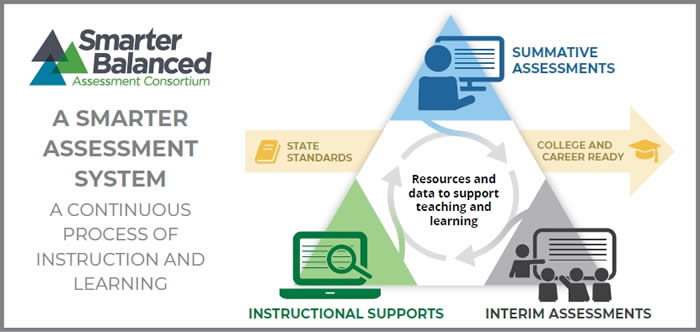
In California, the Smarter Balanced assessment organization provides assessments for, equally, and of learning in an integrated manner. The organization has iii components:
- Summative assessments, measuring grade-level standards for accountability purposes
- Acting assessments, designed to back up teaching and learning throughout the school year
- Tools for Teachers, a website designed to support classroom-based formative assessment practices
All of these are designed to measure the Common Core State Standards and all include performance tasks as well as selected-response and open-concluded response items.
Figure 1. Continuous Process of Instruction and Learning
Accessible version of Figure 1
Interim assessments and formative cess tools are bachelor throughout the twelvemonth to all K–12 teachers in all LEAs, including lease schools. Educators at nonpublic schools who provide direct instruction to California public school students also are eligible to use these assessments.
The Smarter Counterbalanced Interim Assessments are fixed-form (nonadaptive) tests designed to provide meaningful information for gauging student progress toward mastery of the skills measured by the summative assessments, just they also can be used to delve more deeply into item domains and can exist used at whatever indicate along the learning continuum. The interim assessments were developed for students in grades 3 through 8 and loftier schoolhouse, merely may be administered to students at any course level.
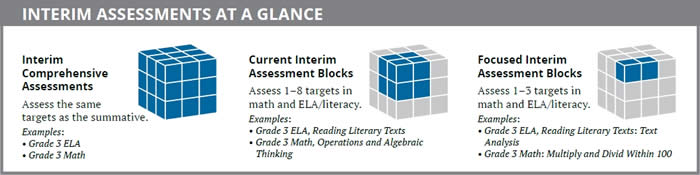
Although California Instruction Code (EC) Section 60642.7(b) does not permit the results from the acting assessments to be used for whatever high-stakes purpose, LEAs may want to utilize the Interim Comprehensive Assessments for an overview of students' condition on form-level standards for their course level during 2019–2020, and and then follow up with groups of students in more specific domains that announced to need more than reinforcement using the Interim Assessment Blocks, which provide more than detailed data to guide didactics in particular areas (due east.g., multiplying and dividing within 100). The acting assessments are described below:
- Interim Comprehensive Assessment (ICAs) are congenital on the aforementioned blueprints as the summative assessments. The ICAs, typically 35 to 45 items in length, include the same detail types and formats, including performance tasks, as the summative assessments, and yield results on the same vertical scales. The ICAs yield overall calibration scores, overall functioning level designations, and merits-level information.
Interim Comprehensive Assessment Blueprint for ELA
(PDF) [https://portal.smarterbalanced.org/library/en/ela-literacy-acting-comprehensive-assessment-blueprint.pdf]
Interim Comprehensive Cess Design for Mathematics (PDF) [https://portal.smarterbalanced.org/library/en/mathematics-interim-comprehensive-assessment-blueprint.pdf] - Interim Assessment Blocks (IABs) focus on smaller sets of targets and, therefore, provide more detailed information for instructional purposes. Kickoff with the 2019–2020 school twelvemonth, a new type of IAB—called the focused IAB—became bachelor. Focused IABs measure smaller bundles of content to requite teachers a better understanding of students' knowledge and academic performance in specific areas and provide teachers with precise next steps for educational activity. Teachers can gather several focused IABs together to evaluate pupil learning in areas of business concern.
Acting Assessment Blocks Blueprint for ELA
(PDF) [https://portal.smarterbalanced.org/library/en/english language-language-artsliteracy-interim-cess-blocks-fixed-course-blueprint.pdf]
Interim Assessment Blocks Design for Mathematics (PDF) [https://portal.smarterbalanced.org/library/en/math-interim-cess-blocks-blueprint.pdf]
Focused Acting Assessment Blocks Blueprint for ELA (PDF) [https://portal.smarterbalanced.org/library/en/english-language-arts-literacy-focused-interim-assessment-blocks-pattern.pdf]
Focused Interim Assessment Blocks Design for Mathematics (PDF) [https://portal.smarterbalanced.org/library/en/mathematics-focused-interim-assessment-blocks.pdf] - More than 160 interim assessments are scheduled to be bachelor August 20, 2020. Results from these assessments will be available electronically to educators within xx minutes of administration in one case whatever necessary hand scoring has been completed. A school or district coordinator will demand to create the student groups that allow teachers to admission these results in the California Educator Reporting System.
Figure two. ICAs, IABs, and Focused IABs
Accessible version of Figure 2
- Tools for Teachers includes lessons and activities with interactive Connections Playlists that tin be used with interim assessments, high-quality resources aligned with learning standards, formative assessment strategies embedded in each resource, and accessibility strategies. Teachers also can employ formative assessment tools and teaching supports from Tools for Teachers. These instructional resources—including lessons and activities, recommended materials, and in-process assessments that tin guide teaching strategies—are linked to the same standards equally those for the interim and summative assessments.
Related Resource
- Acting Assessment Video Serial [https://www.cde.ca.gov/ta/tg/sa/iavideoseries.asp]
This series consists of five video modules developed to help educators effectively utilize the acting cess systems and tools that are needed to select, administrate, paw score, and view and utilise results from the Smarter Counterbalanced Interim Assessments. - Acting Assessments by Class (PDF) [https://www.cde.ca.gov/ta/tg/sa/documents/sbiasbygrade.pdf]
This document provides a list of all interim assessments bachelor by grade, including the claims and targets, full number of items, and number of items that are paw scored. This information is provided to assist LEAs in planning for the administration and local hand scoring of the interim assessments. - Acting Assessments Overview (PDF) [https://portal.smarterbalanced.org/library/en/interim-assessments-overview.pdf]
This document describes the interim assessments, including their purpose, employ, and varieties. For each grade and subject, this document provides a list of interim assessments available for the 2019–2020 school year. - Smarter Content Explorer [https://contentexplorer.smarterbalanced.org/]
This convenient web tool combines the data provided in the Smarter Balanced Content and Item Specifications—primal resources used in test and item development—into an easy-to-use search interface. This tool can help teachers ameliorate understand how test questions are designed to provide testify of what students know and can practise. - Tools for Teachers [https://www.smartertoolsforteachers.org/]
This website includes standards-based lessons, activities, materials, and formative assessments for each domain of the Mutual Cadre State Standards. - Smarter Balanced Remote Teaching and Learning [https://remote.smartertoolsforteachers.org/]
This new website provides suggestions for how teachers can use Smarter Balanced assessment resources when engaged in remote instruction.
Practise and Training Tests
Furthermore, teachers and students tin employ the CAASPP and the ELPAC do and training tests in formative means during instruction. These tests provide them with the opportunity to go familiar with the testing software before acting or summative assessments are administered. They also allow students to admission and answer to the different types of questions they will encounter on the tests. Practice and training tests are available for the following:
- Smarter Balanced ELA
- Smarter Balanced Mathematics
- California Science Test
- California Alternating Assessment (CAA) for ELA
- CAA for Mathematics
- CAA for Scientific discipline
- California Spanish Assessment
- ELPAC
For practice or preparation resources, visit the CAASPP Online Practise and Preparation Tests Portal [http://www.caaspp.org/exercise-and-training/] or the ELPAC Practice and Training Tests web page [https://www.elpac.org/resource/online-exercise-and-training-test/]. Guides for the administration of the CAASPP and ELPAC practice and preparation tests are available on the Section of Teaching (CDE) Quick Reference Guides web page [https://www.cde.ca.gov/ta/tg/ca/caasppqrg.asp].
Other Diagnostic Tools
The CDE has approved a gear up of assessments for diagnostic testing in ELA and mathematics that meet the requirements of EC Section 60644. These assessments take been identified as aligned with the Mutual Core Country Standards and tin be used for tracking learning progress and for guiding pedagogy mapped to student needs. They are listed and described on the CDE website (refer to the Class Two Diagnostic Assessments web page [https://www.cde.ca.gov/ta/tg/da/]) every bit well every bit in table 1, below. (Nosotros annotation that other publishers have inquired virtually adding their resources to this listing; even so, funding is no longer bachelor for vetting additional grade ii diagnostic assessments.) LEAs can certify to the CDE the number of students in course two who are administered these assessments pursuant to EC Section 60644 for the purpose of determining apportionment funding as set by the California State Board of Education annually.
These assessments were initially evaluated for grade ii diagnostic testing, just all are scaled assessments that bear witness how students are progressing along a continuum that extends across form levels and can exist used over multiple school years to inform instruction. LEAs that already use ane of these assessments tin can examine student progress over time from prior years to the present and into the coming year(s).
Tabular array 1. CDE-Approved Diagnostic Assessments
| Assessment | Notes |
|---|---|
| Acuity Common Core* K–12 In English language | Tin be used multiple times per year. Assessments, which include performance tasks, can be used as designed, or tin can be modified by teachers to address specific standards. Assessments are accompanied past instructional resources, which are recommended for each student in a personalized playlist that includes interactive projects and exercises, based on how students perform. Teachers can also create performance tasks using the job and rubric cosmos tool. |
| Developmental Reading Assessment K–8 ELA In English and Spanish | Typically used several times each yr. Individually administered assessment that allows teachers to determine each educatee's independent and instructional reading level by evaluating oral reading fluency, and comprehension. The diagnostic DRA Word Analysis cess provides additional information on how struggling and emerging readers nourish to and work with various components of spoken and written words. The resulting plan documents what each student needs to acquire next and enables teachers to differentiate educational activity and select books at the advisable level. |
| Easy CBM K–six (reading) In English and Spanish | Typically used several times a yr. Assessments are designed for CCSS math and reading standards. Math, vocabulary and reading comprehension assessments are administered online; other measures (letter of the alphabet names, letter of the alphabet sounds, phoneme segmentation, word and passage reading fluency) are administered individually. |
| iReady One thousand–12 In English | A suite of computer-based assessments is designed to provide a complete picture of pupil operation and growth across math and ELA. The suite includes diagnostic and standards mastery assessments, dyslexia screening, and oral reading fluency assessments that can be used coherently to monitor and support student progress. Reports include information about how to interpret both overall scores and growth every bit well every bit operation on individual items, highlighting what each pupil needs to learn adjacent. Results from the are connected to personalized learning pathways and accompanying teacher resource. |
| Measures of Academic Progress K–12 In English and Spanish | A suite of figurer-based assessments in math, ELA, and science
MAP assessments are designed to provide specific data well-nigh what noesis and skills students are ready to learn next and are continued to instructional resources. They are also connected to educatee profiles that provide both growth information and comparisons to other assessments that may be of interest, like Smarter Counterbalanced assessments. |
| mCLASS: Reading 3D / mCLASS Math One thousand–six ELA In English language and Spanish | mCLASS reading 3D assessments are a suite of screening and progress monitoring measures that focus on comprehension and meaning making. These assessments are individually administered using leveled readers from a book fix and completing a series of operation tasks that may include responding to oral comprehension questions, completing a retell, and/or writing responses to comprehension questions. Student scores are connected to developmental progressions and research-based benchmarks. mCLASS math assessments combine screening and progress-monitoring with guided diagnostic interviews to uncover mathematical reasoning and skills. Assessments tin can be administered 1-to-one or through written criterion assessments, and the results of both assessments and diagnostic reviews are reported every bit diagnostic profiles with suggested instructional activities. |
| Performance Series K–12 Reading In English and Spanish | Computer adaptive diagnostic testing. Questions are multiple-selection, and student reports include ranking relative to national percentiles, form-level estimates, and placement of student performance into performance bands. Teachers can connect student functioning to customized learning plans that are related to CCSS learning goals. |
| Riverside Interim Assessments 2–xi ELA | Interim assessments can be administered as pre- and post-tests to monitor learning before and afterwards educational activity. All items are selected response, either stand-alone (math and language) or paired with passages (reading). Student performance is reported through proficiency scores. |
| Star Assessment Yard–3, Star Early Learning packet (includes Star Early Literacy and Star Reading) pre-K–3, Star Early on Literacy Thousand–12, Star Reading 1–12, Star Math In English and Spanish | Star Early on Learning is a bundle of Star Early Literacy and Star Reading. Together, these literacy assessments measure both literacy and numeracy in a single assessment, providing information most phonological awareness, phonics, word recognition, fluency (including estimated oral fluency), vocabulary, and comprehension. Star Early Literacy tests a child's agreement of word noesis and skills, comprehension, meaning, and numbers and operations. Information technology is normed for grades pre-K–3. Star Reading measures a pupil's agreement of vocabulary, power to encompass texts, and power to clarify, sympathize, and evaluate literary and informational texts. It is normed for kindergarten–grade 12. Star Math assesses a student'south grasp of concepts including numbers and operations, algebraic thinking, geometry, measurement, data analysis, statistics, and probability. Star Math is normed for grades 1–12. |
*In improver to the resource listed above, many California districts participate in the Mathematics Assessment Project (MAP) [https://world wide web.map.mathshell.org/], which offers an all-encompassing sequence of determinative assessment lessons and rich summative performance tasks to support the Common Cadre Country Standards. Sponsored past the Mathematics Assessment Resource Service (MARS) [https://www.mathshell.org/ba_mars.htm] at the University of California at Berkeley, MAP works with states and networks of districts, including the Silicon Valley Mathematics Initiative, on the pattern and implementation of operation assessments and on professional evolution for designers and teachers. Many of the tasks designed by MARS as part of its Balanced Assessment in Mathematics (BAM) take been incorporated into the Acuity materials described above.
References
Accessibility Appendix
Accessible Version of Effigy 1. Continuous Process of Instruction and Learning
Paradigm from the Smarter Blanced Assessment Consortium that demonstrates a smarter assessment system, which includes a continuous process of teaching and learning. State standards lead to higher and career readiness. Resource and data to support teaching and learning are provided by three integrated components: summative assessments, interim assessments, and instructional supports (tools for teachers).
Back to Content Afterwards Figure 1
Accessible Version of Figure 2. ICAs, IABs, and Focused IABs
Interim Assessments at a Glance
Acting Comprehensive Assessments
Image of a three by three by three cube with all parts filled.
Appraise the same targets as the summative. Examples:
- Grade 3 ELA
- Grade 3 Math
Electric current Interim Assessment Blocks
Prototype of a three past three by three cube, with a 2 by ii by two cube portion filled.
Assess i-eight targets in math and ELA/literacy. Examples:
- Grade 3 ELA, Reading Literacy Texts
- Grade iii Math, Operations and Algebraic Thinking
Focused Interim Assessment Blocks
Image of a 3 by three by iii cube with a two by ane by one portion filled. The two past one past one filled portion is within the portion that had been a 2 by two by ii portion.
Assess 1-iii targets in math and ELA/literacy. Examples:
- Grade three ELA, Reading Literacy Texts: Text Analysis
- Course three Math: Multiply and Split up within 100
Back to Content Later on Figure 2
Last Reviewed: Tuesday, Feb 22, 2022
Source: https://www.cde.ca.gov/ls/he/hn/guidanceonassessments.asp
0 Response to "The Diagnostic Assessments of Reading With Trial Teach Strategies (Dar-tts)"
Publicar un comentario