You Are a Social Detective Being Read to Kids



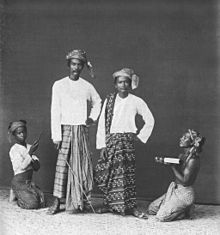
From summit-left to lesser-right or from acme to lesser (mobile): a samurai and his servant, c. 1846; The Slave Trader, painting by Géza Udvary, unknown date; a butler places a telephone call, 1922; The Bower Garden, painting by Dante Gabriel Rossetti, 1859
A social class is a set of concepts in the social sciences and political theory centered on models of social stratification which occur in a class society, in which people are grouped into a set of hierarchical social categories,[1] the most common beingness the upper, eye and lower classes. Membership in a social class can for example be dependent on education, wealth, occupation, income, and belonging to a particular subculture or social network.[two]
"Form" is a bailiwick of analysis for sociologists, political scientists, anthropologists and social historians. The term has a broad range of sometimes alien meanings, and there is no broad consensus on a definition of "form". Some people argue that due to social mobility, class boundaries do not exist. In common parlance, the term "social class" is ordinarily synonymous with "socio-economical grade", divers as "people having the same social, economical, cultural, political or educational status", due east.g., "the working grade"; "an emerging professional class".[3] However, academics distinguish social grade and socioeconomic status, using the former to refer to one's relatively stable sociocultural background and the latter to refer to one's electric current social and economic situation which is consequently more than changeable over time.[4]
The precise measurements of what determines social class in club have varied over time. Karl Marx idea "class" was defined by one'due south relationship to the means of production (their relations of product). His understanding of classes in modern capitalist social club is that the proletariat work but do non ain the means of product, and the bourgeoisie, those who invest and live off the surplus generated by the proletariat'southward operation of the ways of production, practise not piece of work at all. This contrasts with the view of the sociologist Max Weber, who argued "course" is adamant by economic position, in contrast to "social status" or "Stand" which is determined by social prestige rather than but just relations of product.[v] The term "class" is etymologically derived from the Latin classis, which was used by census takers to categorize citizens past wealth in order to determine military service obligations.[6]
In the late 18th century, the term "class" began to supplant classifications such as estates, rank and orders as the primary ways of organizing society into hierarchical divisions. This corresponded to a general decrease in significance ascribed to hereditary characteristics and increase in the significance of wealth and income equally indicators of position in the social bureaucracy.[seven] [viii]
History [edit]
Ancient Egypt [edit]
The existence of a class system dates dorsum to times of Ancient Egypt, where the position of elite was also characterized by literacy.[9] The wealthier people were at the tiptop in the social order and common people and slaves being at the bottom.[10] However, the class was non rigid; a man of apprehensive origins could arise to a high postal service.[xi] : 38-
The aboriginal Egyptians viewed men and women, including people from all social classes, every bit essentially equal under the constabulary, and even the lowliest peasant was entitled to petition the vizier and his court for redress.[12]
Farmers made upwards the majority of the population, but agricultural produce was owned straight by the state, temple, or noble family that owned the land.[13] : 383 Farmers were also subject to a labor tax and were required to piece of work on irrigation or construction projects in a corvée arrangement.[xiv] : 136 Artists and craftsmen were of higher status than farmers, but they were as well nether state control, working in the shops fastened to the temples and paid directly from the state treasury. Scribes and officials formed the upper grade in ancient Arab republic of egypt, known as the "white kilt class" in reference to the bleached linen garments that served as a mark of their rank.[15] : 109 The upper course prominently displayed their social status in art and literature. Beneath the nobility were the priests, physicians, and engineers with specialized training in their field. It is unclear whether slavery as understood today existed in ancient Egypt; there is difference of opinions among authors.[16]

Slave chirapsia in ancient Arab republic of egypt
Not a unmarried Egyptian was, in our sense of the word, free. No individual could call in question a hierarchy of potency which culminated in a living god.
Although slaves were mostly used every bit indentured servants, they were able to buy and sell their servitude, work their style to freedom or nobility, and were usually treated by doctors in the workplace.[17]
Elsewhere [edit]
In Aboriginal Greece when the clan system [a] was declining. The classes[b] replaced the clan lodge when it get too pocket-size to sustain the needs of increasing population.The partitioning of labor is also essential for the growth of classes.[11] : 39
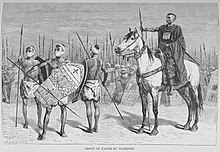
Nigerian warriors armed with spears in the retinue of a mounted state of war main. The Earth and Its Inhabitants, 1892
Historically, social class and behavior were laid downward in law. For example, permitted mode of dress in some times and places was strictly regulated, with sumptuous dressing only for the loftier ranks of society and aristocracy, whereas sumptuary laws stipulated the dress and jewelry appropriate for a person's social rank and station. In Europe, these laws became increasingly commonplace during the Heart Ages. Even so, these laws were decumbent to change due to societal changes, and in many cases, these distinctions may either most disappear, such as the distinction between a patrician and a plebeian being almost erased during the belatedly Roman Republic.
Jean-Jacques Rousseau had a large influence over political ideals of the French Revolution because of his views of inequality and classes. Rousseau saw humans equally "naturally pure and good," meaning that humans from birth were seen every bit innocent and any evilness was learned. He believed that social problems arise through the evolution of society and suppress the innate pureness of humankind. He also believed that private property is the principal reason for social issues in society because private property creates inequality through the holding's value. Even though his theory predicted if there were no private property and so there would be wide spread equality, Rousseau accepted that there will e'er be social inequality because of how club is viewed and run.[18]
Later Enlightenment thinkers viewed inequality as valuable and crucial to society's development and prosperity. They also acknowledged that private property will ultimately cause inequality because specific resources that are privately owned tin be stored and the owners profit off of the deficit of the resources. This can create contest betwixt the classes that was seen equally necessary by these thinkers.[18] This too creates stratification between the classes keeping a distinct difference between lower, poorer classes and the college, wealthier classes.
India (↑), Nepal, N Korea (↑), Sri Lanka (↑) and some Indigenous peoples maintain social classes today.
In grade societies, class disharmonize has tended to recur or is ongoing, depending on the sociological and anthropolitical perspective.[19] [xx] Class societies have not always existed; there have been widely unlike types of class communities.[21] [22] [23] For example, societies based on age rather than capital.[24] During colonialism, social relations were dismantled past force, which gave ascension to societies based on the social categories of waged labor, private property, and capital.[24] [25]
Form society [edit]
Form society or course-based society is an organizing principle gild in which ownership of belongings, means of production, and wealth is the determining factor of the distribution of power, in which those with more holding and wealth are stratified higher in the society and those without access to the ways of production and without wealth are stratified lower in the society. In a class club, at to the lowest degree implicitly, people are divided into distinct social strata, commonly referred to as social classes or castes. The nature of class society is a affair of sociological research.[26] [27] [28] Form societies exist all over the world in both industrialized and developing nations.[29] Class stratification is theorized to come directly from commercialism.[30] In terms of public stance, 9 out of ten people in a Swedish survey considered it correct that they are living in a grade society.[31]
Comparative sociological research [edit]
One may use comparative methods to study course societies, using, for example, comparison of Gini coefficients, de facto educational opportunities, unemployment, and civilisation.[32] [33]
Effect on the population [edit]
Societies with large class differences have a greater proportion of people who suffer from mental health issues such every bit anxiety and depression symptoms.[34] [35] [36] A serial of scientific studies take demonstrated this relationship.[37] Statistics support this assertion and results are found in life expectancy and overall wellness; for example, in the case of high differences in life expectancy between 2 Stockholm suburbs. The differences betwixt life expectancy of the poor and less-well-educated inhabitants who alive in proximity to the station Vårby gård, and the highly educated and more affluent inhabitants living near Danderyd differ by 18 years.[38] [39]
Similar data virtually New York is besides available for life expectancy, boilerplate income per capita, income distribution, median income mobility for people who grew upwardly poor, share with a bachelor's degree or higher.[40]
In course societies, the lower classes systematically receive lower-quality education and intendance.[41] [42] [43] At that place are more explicit effects where those within the college class actively demonize parts of the lower-class population.[33]
Theoretical models [edit]
Definitions of social classes reflect a number of sociological perspectives, informed by anthropology, economic science, psychology and sociology. The major perspectives historically accept been Marxism and structural functionalism. The common stratum model of form divides club into a unproblematic hierarchy of working class, heart class and upper class. Within academia, two broad schools of definitions emerge: those aligned with 20th-century sociological stratum models of course society and those aligned with the 19th-century historical materialist economic models of the Marxists and anarchists.[44] [45] [46]
Another stardom can be drawn between analytical concepts of social class, such equally the Marxist and Weberian traditions, likewise as the more empirical traditions such as socioeconomic status approach, which notes the correlation of income, teaching and wealth with social outcomes without necessarily implying a particular theory of social structure.[47]
Marxist [edit]
"[Classes are] large groups of people differing from each other by the place they occupy in a historically determined arrangement of social production, by their relation (in almost cases fixed and formulated in law) to the ways of production, by their role in the social organization of labor, and, consequently, past the dimensions of the share of social wealth of which they dispose and the fashion of acquiring it."
—Vladimir Lenin, A Great Commencement on June 1919
For Marx, grade is a combination of objective and subjective factors. Objectively, a class shares a common relationship to the ways of product. The grade guild itself is understood as the aggregated phenomenon to the "interlinked motility", which generates the quasi-objective concept of capital.[48] Subjectively, the members will necessarily have some perception ("class consciousness") of their similarity and common interest. Form consciousness is not simply an awareness of one's own class interest but is too a set up of shared views regarding how society should be organized legally, culturally, socially and politically. These class relations are reproduced through fourth dimension.
In Marxist theory, the class structure of the backer mode of production is characterized by the disharmonize between two primary classes: the bourgeoisie, the capitalists who own the means of production and the much larger proletariat (or "working course") who must sell their ain labour power (wage labour). This is the cardinal economic construction of piece of work and property, a state of inequality that is normalized and reproduced through cultural ideology.
For Marxists, every person in the process of production has separate social relationships and bug. Along with this, every person is placed into different groups that take similar interests and values that tin differ drastically from group to group. Grade is special in that does not relate to specifically to a singular person, but to a specific role.[18]
Marxists explicate the history of "civilized" societies in terms of a war of classes between those who control product and those who produce the goods or services in society. In the Marxist view of capitalism, this is a disharmonize between capitalists (bourgeoisie) and wage-workers (the proletariat). For Marxists, class antagonism is rooted in the situation that control over social production necessarily entails control over the class which produces appurtenances—in capitalism this is the exploitation of workers by the suburbia.[49]
Furthermore, "in countries where mod civilisation has become fully developed, a new class of petty bourgeois has been formed".[fifty] "An industrial army of workmen, nether the command of a capitalist, requires, like a real army, officers (managers) and sergeants (foremen, over-lookers) who, while the work is being done, control in the name of the capitalist".[51]
Marx makes the statement that, as the bourgeoisie reach a indicate of wealth aggregating, they hold enough power as the dominant grade to shape political institutions and society according to their own interests. Marx then goes on to claim that the non-elite class, owing to their large numbers, take the power to overthrow the elite and create an equal social club.[52]
In The Communist Manifesto, Marx himself argued that it was the goal of the proletariat itself to displace the backer arrangement with socialism, changing the social relationships underpinning the class organization then developing into a future communist society in which: "the free development of each is the condition for the complimentary development of all". This would marker the starting time of a classless society in which human needs rather than profit would be motive for production. In a society with democratic control and production for use, at that place would be no class, no state and no demand for financial and banking institutions and coin.[53] [54]
These theorists have taken this binary class system and expanded information technology to include contradictory class locations, the idea that a person tin be employed in many different class locations that fall between the ii classes of proletariat and suburbia. Erik Olin Wright stated that class definitions are more than various and elaborate through identifying with multiple classes, having familial ties with people in unlike a class, or having a temporary leadership role.[xviii]
Weberian [edit]
Max Weber formulated a three-component theory of stratification that saw social class as emerging from an coaction between "course", "status" and "power". Weber believed that form position was determined past a person's relationship to the means of production, while status or "Stand" emerged from estimations of honor or prestige.[55]
Weber views form as a grouping of people who have common goals and opportunities that are available to them. This means that what separates each course from each other is their value in the marketplace through their own goods and services. This creates a carve up betwixt the classes through the assets that they have such as holding and expertise.[18]
Weber derived many of his key concepts on social stratification by examining the social structure of many countries. He noted that contrary to Marx'southward theories, stratification was based on more than than simply ownership of capital. Weber pointed out that some members of the aristocracy lack economic wealth yet might nevertheless have political power. Too in Europe, many wealthy Jewish families lacked prestige and accolade because they were considered members of a "pariah group".
- Class: A person's economic position in a society. Weber differs from Marx in that he does not run across this as the supreme factor in stratification. Weber noted how managers of corporations or industries control firms they practise not ain.
- Status: A person'south prestige, social honour or popularity in a society. Weber noted that political power was not rooted in capital letter value solely, but also in ane's condition. Poets and saints, for instance, can possess immense influence on order with frequently lilliputian economic worth.
- Ability: A person's ability to get their style despite the resistance of others. For instance, individuals in state jobs, such as an employee of the Federal Bureau of Investigation, or a fellow member of the United States Congress, may hold fiddling property or status, just they nevertheless hold immense power.
Bourdieu [edit]
For Bourdieu, the place in the social strata for any person is vaguer than the equivalent in Weberian sociology. Bourdieu introduced an array of concepts of what he refers to every bit types of capital. These types were economic capital, in the form assets convertible to money and secured as private belongings. This type of capital is separated from the other types of culturally constituted types of capital, which Bourdieu introduces, which are: personal cultural capital letter (formal education, knowledge); objective cultural capital (books, art); and institutionalized cultural capital (honours and titles).
Great British Class Survey [edit]
On 2 April 2013, the results of a survey[56] conducted by BBC Lab Great britain adult in collaboration with academic experts and slated to be published in the journal Sociology were published online.[57] [58] [59] [sixty] [61] The results released were based on a survey of 160,000 residents of the United kingdom most of whom lived in England and described themselves as "white". Class was defined and measured according to the amount and kind of economic, cultural and social resources reported. Economical capital was divers as income and assets; cultural upper-case letter as amount and type of cultural interests and activities; and social capital as the quantity and social status of their friends, family unit and personal and business organization contacts.[60] This theoretical framework was developed past Pierre Bourdieu who first published his theory of social stardom in 1979.
Iii-level economic grade model [edit]
Today, concepts of social grade often assume 3 general economic categories: a very wealthy and powerful upper class that owns and controls the ways of production; a middle grade of professional person workers, minor business owners and depression-level managers; and a lower class, who rely on low-paying jobs for their livelihood and experience poverty.
Upper form [edit]

A symbolic paradigm of three orders of feudal guild in Europe prior to the French Revolution, which shows the rural third manor carrying the clergy and the nobility
The upper class[62] is the social class composed of those who are rich, well-born, powerful, or a combination of those. They usually wield the greatest political power. In some countries, wealth alone is sufficient to permit entry into the upper grade. In others, only people who are born or ally into certain aristocratic bloodlines are considered members of the upper class and those who gain slap-up wealth through commercial activity are looked downwardly upon by the aristocracy as nouveau riche.[63] In the United kingdom, for example, the upper classes are the aristocracy and royalty, with wealth playing a less of import role in class status. Many aristocratic peerages or titles take seats attached to them, with the holder of the title (eastward.thousand. Earl of Bristol) and his family existence the custodians of the firm, merely not the owners. Many of these require loftier expenditures, so wealth is typically needed. Many aristocratic peerages and their homes are parts of estates, owned and run by the title holder with moneys generated by the land, rents or other sources of wealth. However, in the United States where at that place is no aristocracy or royalty, the upper class status belongs to the extremely wealthy, the and then-called "super-rich", though at that place is some tendency fifty-fifty in the Us for those with old family wealth to expect downwards on those who have earned their money in business, the struggle between new money and former money.
The upper course is generally independent within the richest one or two percent of the population. Members of the upper course are often born into it and are distinguished by immense wealth which is passed from generation to generation in the course of estates.[64] Based on some new social and political theories upper course consists of the most wealthy decile grouping in order which holds near 87% of the whole society'due south wealth.[65]
Middle class [edit]
Encounter also: Middle-class clasp
The centre grade is the near contested of the iii categories, the broad group of people in gimmicky order who fall socio-economically betwixt the lower and upper classes.[66] I example of the contest of this term is that in the United States "center grade" is practical very broadly and includes people who would elsewhere be considered working form. Middle-class workers are sometimes called "white-collar workers".
Theorists such as Ralf Dahrendorf take noted the tendency toward an enlarged middle class in modern Western societies, particularly in relation to the necessity of an educated work strength in technological economies.[67] Perspectives concerning globalization and neocolonialism, such as dependency theory, propose this is due to the shift of depression-level labour to developing nations and the Third Globe.[68]
Middle course is the group of people with typical-everyday jobs that pay significantly more than the poverty line. Examples of these types of jobs are factory workers, salesperson, teacher, cooks and nurses. At that place is a new trend by some scholars which assumes that the size of the middle form in every society is the aforementioned. For example, in paradox of interest theory, middle class are those who are in 6th–ninth decile groups which hold nearly 12% of the whole society'south wealth.[69]
Lower class [edit]

In the United States the lowest stratum of the working course, the underclass, often lives in urban areas with low-quality civil services
Lower class (occasionally described as working class) are those employed in low-paying wage jobs with very little economic security. The term "lower class" likewise refers to persons with depression income.
The working class is sometimes separated into those who are employed just lacking financial security (the "working poor") and an underclass—those who are long-term unemployed and/or homeless, especially those receiving welfare from the country. The latter is today considered coordinating to the Marxist term "lumpenproletariat". However, during the time of Marx's writing the lumpenproletariat referred to those in dire poverty; such equally the homeless.[62] Members of the working class are sometimes chosen blueish-collar workers.
Consequences of course position [edit]
A person's socioeconomic grade has wide-ranging effects. It can touch the schools they are able to attend,[70] [71] [72] [73] [74] [75] their wellness,[76] the jobs open to them,[lxx] when they exit the labour market,[77] whom they may marry[78] and their handling by police and the courts.[79]
Angus Deaton and Anne Case have analyzed the bloodshed rates related to the group of white, eye-aged Americans betwixt the ages of 45 and 54 and its relation to course. There has been a growing number of suicides and deaths by substance abuse in this particular group of middle-class Americans. This group also has been recorded to have an increment in reports of chronic hurting and poor general wellness. Deaton and Case came to the conclusion from these observations that because of the constant stress that these white, eye anile Americans feel fighting poverty and wavering between the middle and lower classes, these strains have taken a toll on these people and affected their whole bodies.[76]
Social classifications can also determine the sporting activities that such classes take office in. It is suggested that those of an upper social class are more likely to accept function in sporting activities, whereas those of a lower social groundwork are less likely to participate in sport. However, upper-class people tend to not take part in certain sports that accept been commonly known to be linked with the lower class.[80]
[edit]
Didactics [edit]
A person'south social class has a significant impact on their educational opportunities. Non merely are upper-course parents able to ship their children to exclusive schools that are perceived to be improve, but in many places, land-supported schools for children of the upper class are of a much college quality than those the land provides for children of the lower classes.[81] [82] [83] [84] [85] [86] This lack of expert schools is one factor that perpetuates the grade divide beyond generations.
In the UK, the educational consequences of class position accept been discussed past scholars inspired by the cultural studies framework of the CCCS and/or, especially regarding working-course girls, feminist theory. On working-course boys, Paul Willis' 1977 book Learning to Labour: How Working Form Kids Get Working Class Jobs is seen within the British Cultural Studies field as a classic give-and-take of their contempt to the acquisition of noesis.[87] Beverley Skeggs described Learning to Labour as a study on the "irony" of "how the process of cultural and economic reproduction is made possible by 'the lads' ' celebration of the hard, macho globe of work."[88]
Health and nutrition [edit]
A person'south social course has a significant touch on their physical health, their power to receive adequate medical intendance and diet and their life expectancy.[89] [90] [91]
Lower-grade people experience a wide array of wellness problems equally a issue of their economic status. They are unable to use health care as ofttimes and when they exercise it is of lower quality, even though they mostly tend to experience a much college rate of health issues. Lower-class families accept higher rates of infant bloodshed, cancer, cardiovascular disease and disabling concrete injuries. Additionally, poor people tend to work in much more hazardous weather condition, yet by and large have much less (if any) wellness insurance provided for them, as compared to middle- and upper-class workers.[92]
Employment [edit]
The atmospheric condition at a person's task vary greatly depending on class. Those in the upper-middle course and middle class enjoy greater freedoms in their occupations. They are unremarkably more than respected, enjoy more diversity and are able to exhibit some authority.[93] Those in lower classes tend to feel more alienated and take lower work satisfaction overall. The physical conditions of the workplace differ greatly between classes. While middle-form workers may "endure alienating weather" or "lack of job satisfaction", blue-collar workers are more apt to suffer alienating, oft routine, work with obvious physical health hazards, injury and even death.[94]
In the Britain, a 2015 government study by the Social Mobility Committee suggested the beingness of a "drinking glass floor" in British society preventing those who are less able, just who come up from wealthier backgrounds, from slipping downwards the social ladder. The study proposed a 35% greater likelihood of less able, amend-off children condign loftier earners than bright poor children.[95]
Class conflict [edit]
Course disharmonize, frequently referred to every bit "class warfare" or "class struggle", is the tension or animosity which exists in society due to competing socioeconomic interests and desires between people of different classes.
For Marx, the history of form society was a history of class conflict. He pointed to the successful ascent of the bourgeoisie and the necessity of revolutionary violence—a heightened form of class disharmonize—in securing the conservative rights that supported the capitalist economy.
Marx believed that the exploitation and poverty inherent in commercialism were a pre-existing form of class disharmonize. Marx believed that wage labourers would need to revolt to bring about a more equitable distribution of wealth and political power.[96] [97]
Classless society [edit]
A "classless" society is 1 in which no 1 is born into a social class. Distinctions of wealth, income, education, culture or social network might arise and would only be determined by individual feel and achievement in such a social club.
Since these distinctions are difficult to avoid, advocates of a classless guild (such as anarchists and communists) propose various means to achieve and maintain information technology and attach varying degrees of importance to information technology as an end in their overall programs/philosophy.
Human relationship between ethnicity and class [edit]

Race and other large-scale groupings tin can besides influence class standing. The association of particular ethnic groups with class statuses is common in many societies, and is linked with race also.[98] Class and ethnicity can touch on a persons, or communities, Socioeconomic standing, which in turn influences everything including task availability and the quality of bachelor wellness and teaching.[99]
As a result of conquest or internal ethnic differentiation, a ruling class is ofttimes ethnically homogenous and particular races or indigenous groups in some societies are legally or customarily restricted to occupying particular class positions. Which ethnicities are considered as belonging to loftier or low classes varies from club to society.
In modernistic societies, strict legal links between ethnicity and class take been drawn, such every bit the caste system in Africa, apartheid, the position of the Burakumin in Japanese society and the casta organization in Latin America.[ citation needed ]
See also [edit]
- Grade stratification
- Degree
- Migrate hypothesis
- Elite theory
- Elitism
- Iv occupations
- Wellness equity
- Hostile architecture
- Inca society
- Korean ruling class
- Mass guild
- National Statistics Socio-economical Classification
- Passing (sociology)
- Post-industrial guild
- Ranked society
- Raznochintsy
- Psychology of social class
- Social stratification
- Welfare state
Notes [edit]
- ^ based on blood relations
- ^ based on occupation
References [edit]
- ^ Grant, J. Andrew (2001). "form, definition of". In Jones, R.J. Barry (ed.). Routledge Encyclopedia of International Political Economic system: Entries A–F. Taylor & Francis. p. 161. ISBN978-0-415-24350-6.
- ^ "The Class Construction in the U.Due south. | Boundless Sociology". courses.lumenlearning.com . Retrieved 5 March 2021.
- ^ Princeton University. "Social class". WordNet Search three.1. Retrieved on: 2012-01-25.
- ^ Rubin, M., Denson, N., Kilpatrick, Southward., Matthews, K.E., Stehlik, T., & Zyngier, D. (2014). ""I am working-course": Subjective self-definition equally a missing measure of social class and socioeconomic condition in higher didactics inquiry". Educational Researcher. 43 (4): 196–200. doi:10.3102/0013189X14528373. hdl:1959.13/1043609. S2CID 145576929.
{{cite journal}}: CS1 maint: uses authors parameter (link) - ^ Weber, Max (1921/2015). "Classes, Stände, Parties" in Weber's Rationalism and Modern Club: New Translations on Politics, Bureaucracy and Social Stratification. Edited and Translated by Tony Waters and Dagmar Waters, pp. 37–58.
- ^ Brown, D.F. (2009). "Social grade and Status". In Mey, Jacob (ed.). Concise Encyclopedia of Pragmatics. Elsevier. p. 952. ISBN978-0-08-096297-nine.
- ^ Kuper, Adam, ed. (2004). "Class, Social". The social science encyclopedia. Taylor & Francis. p. 111. ISBN978-0-415-32096-2.
- ^ Penney, Robert (2003). "Class, social". In Christensen, Karen; Levinson, David (eds.). Encyclopedia of community: from the village to the virtual world, Volume i. SAGE. p. 189. ISBN978-0-7619-2598-9.
- ^ Barbara Mendoza (5 October 2017). Artifacts from Ancient Egypt. ABC-CLIO. pp. 216–. ISBN978-1-4408-4401-0.
- ^ Tracey Baptiste (15 December 2015). The Totally Gross History of Ancient Egypt. The Rosen Publishing Grouping, Inc. pp. 5–. ISBN978-one-4994-3755-3.
- ^ a b c Keller, Suzanne (2017). Beyond the Ruling Grade: Strategic Elites in Modernistic Society. Routledge. ISBN9781351289184.
- ^ Johnson, Janet H. (2002). "Women'southward Legal Rights in Ancient Arab republic of egypt". Fathom Annal. Academy of Chicago.
- ^ Manuelian, Peter Der (1998). Regine Schulz; Matthias Seidel (eds.). Egypt: The Globe of the Pharaohs. Cologne, Deutschland: Könemann. ISBN978-3-89508-913-8.
- ^ James, T.G.H. (2005). The British Museum Curtailed Introduction to Ancient Egypt. University of Michigan Press. ISBN978-0-472-03137-5.
- ^ Billard, Jules B. (1978). Ancient Egypt, Discovering Its Splendors. National Geographic Gild. ISBN9780870442209.
- ^ "Social classes in ancient Egypt". Digital Egypt for Universities. University College London. 2003. Archived from the original on 13 December 2007.
- ^ "Slavery". An introduction to the history and culture of Pharaonic Egypt. Archived from the original on xxx August 2012.
- ^ a b c d due east Conley, Dalton (2017). "Stratification". In Bakeman, Karl (ed.). You May Ask Yourself: An Introduction to Thinking like a Sociologist (5th ed.). W.Due west. Norton & Company, Inc. ISBN978-0393614275.
- ^ The concise encyclopedia of sociology. Wiley-Blackwell. 2011. p. 66. ISBN978-ane-4443-9263-0. OCLC 701327736.
- ^ Weapons of the weak : everyday forms of peasant resistance. ISBN978-0-585-36330-1. OCLC 317459153.
- ^ EVOLUTION OF PROPERTY FROM SAVAGERY TO Civilization. HANSEBOOKS. 2017. ISBN978-3-337-31218-three. OCLC 1104923720.
- ^ Ancient society. Transaction Publishers. 2000. ISBN0-7658-0691-6. OCLC 44516641.
- ^ Encyclopedia of Western colonialism since 1450. Macmillan Reference U.s.. 2007. pp. 620, 849, 921, 64. ISBN978-0-02-866085-i. OCLC 74840473.
- ^ a b Age class systems : social institutions and polities based on age. Cambridge University Press. 1985. ISBN0-521-30747-3. OCLC 11621536.
- ^ https://www.law.uci.edu/lawreview/vol4/no1/Bhandar.pdf[ bare URL PDF ]
- ^ Drobnic, S.; Guillén, A. (2011). Work-Life Balance in Europe: The Role of Job Quality. Springer. p. 208. ISBN9780230307582.
- ^ "Essays on Social Reproduction and Lifelong Learning". Skolporten. xiv April 2010. Retrieved 14 May 2020.
- ^ Bihagen, Erik; Nermo, Magnus; Stern, Charlotta (October 2013). "Form Origin and Elite Position of Men in Business Firms in Sweden, 1993–2007: The Importance of Education, Cognitive Power, and Personality". European Sociological Review. 29 (five): 939–954. doi:x.1093/esr/jcs070.
- ^ "Global Stratification and Inequality | Introduction to Folklore". courses.lumenlearning.com . Retrieved 1 June 2020.
- ^ Lane, David (i December 2005). "Social class as a factor in the transformation of state socialism". Journal of Communist Studies and Transition Politics. 21 (iv): 417–435. doi:10.1080/13523270500363361. ISSN 1352-3279. S2CID 154779478.
- ^ "Klassamhället åter anser 9 av 10" (in Swedish). 26 April 2004. ISSN 1101-2412.
- ^ https://world wide web.ifs.org.u.k./docs/ER_JC_2013.pdf[ blank URL PDF ]
- ^ a b Jones, Owen Peter (2011). Chavs : the demonization of the working class : with new preface ([New] ed.). ISBN978-1-78168-398-ix. OCLC 1105199910.
- ^ Wilkinson, Richard Thousand; Pickett, Kate (2019). The inner level : how more equal societies reduce stress, restore sanity and meliorate everyone's well-being. Penguin Books. ISBN978-0-xiv-197539-9. OCLC 1091644373.
- ^ Salmi, Peter (xiii December 2017). "Kraftig ökning av psykisk ohälsa bland barn och unga vuxna". Socialstyrelsen (in Swedish). Archived from the original on 21 Feb 2018.
- ^ Mathisen, Daniel (viii June 2018). "Inte konstigt att klassamhället får oss att må dåligt" (in Swedish). Archived from the original on xx June 2019. Retrieved 14 May 2020.
- ^ Aneshensel, Ballad S; Phelan, Jo C (1999). Handbook of the sociology of mental health. Kluwer Academic/Plenum Publishers. p. 152. ISBN978-0-387-36223-6. OCLC 552063104.
- ^ "Var du bor avgör när du dör" (in Swedish). 12 May 2014.
- ^ "Mera om massiva och dödliga klasskillnader" (in Swedish). 29 June 2019. ISSN 1101-2412.
- ^ Leonhardt, David; Serkez, Yaryna (xiii May 2020). "Opinion | What Does Opportunity Look Similar Where You Live?". The New York Times.
- ^ "Skillnad mellan rika och fattigas överlevnad i bröstcancer".
- ^ Closing the gap in a generation : wellness disinterestedness through action on the social determinants of health : Commission on Social Determinants of Health terminal report. World Health System, Committee on Social Determinants of Wellness. 2008. ISBN978-92-4-156370-three. OCLC 248038286.
- ^ "Fattiga klarar cancer sämst" (in Swedish). viii September 2008. ISSN 1101-2412.
- ^ Serravallo, Vincent (2008). "Grade". In Parrillo, Vincent N. (ed.). Encyclopedia of social issues, Volume 1. SAGE. p. 131. ISBN978-ane-4129-4165-5.
- ^ Gilbert, Dennis (1998). The American Class Structure . New York: Wadsworth Publishing. ISBN978-0-534-50520-2.
- ^ Williams, Brian; Stacey C. Sawyer; Carl M. Wahlstrom (2005). Marriages, Families & Intimate Relationships. Boston: Pearson. ISBN978-0-205-36674-3.
- ^ John Scott, Course: critical concepts (1996) Volume ii P. 310
- ^ https://libcom.org/file [ permanent dead link ] /Moishe%20Postone%twenty-%20Time,%20Labor,%20and%20Social%20Domination.pdf
- ^ Karl Marx & Friedrich Engels. "Manifesto of the Communist Party", Selected Works, Volume 1; London,' 1943; p. 231.
- ^ Karl Marx & Friedrich Engels. "Manifesto of the Communist Party", Selected Works, Volume 1; London,' 1943; p. 231
- ^ Karl Marx. Capital: An Analysis of Capitalist Production, Volume 1; Moscow; 1959; p. 332.
- ^ "Manifesto of the Communist Party". www.marxists.org . Retrieved 9 Dec 2015.
- ^ Karl Marx & Friedrich Engels. "Manifesto of the Communist Political party", Selected Works, Volume 1; London,' 1943; p. 232-234.
- ^ Karl Marx Critique of the Gotha Program (1875)
- ^ Weber, Max (2015/1921). "Classes, Stände, Parties" in Weber's Rationalism and Modern Guild, edited and translated by Tony Waters and Dagmar Waters, pp. 37–57.
- ^ "Britain'southward Real Class System: Nifty British Grade Survey". BBC Lab UK. Retrieved 4 April 2013. [ permanent dead link ]
- ^ Vicious, Mike; Devine, Fiona; Cunningham, Niall; Taylor, Marking; Li, Yaojun; Johs. Hjellbrekke; Brigitte Le Roux; Friedman, Sam; Miles, Andrew (ii April 2013). "A New Model of Social Class: Findings from the BBC'south Great British Class Survey Experiment" (PDF). Folklore. 47 (2): 219–50. doi:10.1177/0038038513481128. S2CID 85546872.
- ^ "The Keen British class figurer: People in the UK now fit into seven social classes, a major survey conducted past the BBC suggests". BBC. 3 April 2013. Retrieved 4 Apr 2013.
- ^ Savage, Mike; Devine, Fiona (3 April 2013). "The Great British class calculator: Sociologists are interested in the idea that grade is about your cultural tastes and activities as well as the type and number of people you know". BBC . Retrieved 4 April 2013.
- ^ a b Fell, Mike; Devine, Fiona (3 Apr 2013). "The Neat British form estimator: Mike Savage from the London Schoolhouse of Economics and Fiona Devine from the University of Manchester draw their findings from The Bang-up British Grade Survey. Their results identify a new model of class with seven classes ranging from the Elite at the top to a 'Precariat' at the bottom". BBC . Retrieved four April 2013.
- ^ Lyall, Sarah (3 April 2013). "Multiplying the Old Divisions of Course in Britain". The New York Times . Retrieved iv April 2013.
- ^ a b Brown, D.F. (2009). "Social class and Status". In Mey, Jacob (ed.). Concise Encyclopedia of Pragmatics. Elsevier. p. 953. ISBN978-0-08-096297-9.
- ^ The Random Business firm Lexicon of the English language Language, "nouveau riche French Unremarkably Disparaging. a person who is newly rich", 1969, Random House
- ^ Akhbar-Williams, Tahira (2010). "Class Construction". In Smith, Jessie C. (ed.). Encyclopedia of African American Popular Culture, Book 1. ABC-CLIO. p. 322. ISBN978-0-313-35796-1.
- ^ Baizidi, Rahim (2 September 2019). "Paradoxical form: paradox of interest and political conservatism in middle class". Asian Journal of Political Science. 27 (3): 272–285. doi:ten.1080/02185377.2019.1642772. ISSN 0218-5377. S2CID 199308683.
- ^ Stearns, Peter N., ed. (1994). "Middle class". Encyclopedia of social history. Taylor & Francis. p. 621. ISBN978-0-8153-0342-8.
- ^ Dahrendorf, Ralf. (1959) Class and Class Disharmonize in Industrial Society. Stanford: Stanford Academy Press.
- ^ Bornschier V. (1996), 'Western society in transition' New Brunswick, North.J.: Transaction Publishers.
- ^ Baizidi, Rahim (17 July 2019). "Paradoxical class: paradox of interest and political conservatism in center grade". Asian Periodical of Political Science. 27 (3): 272–285. doi:ten.1080/02185377.2019.1642772. ISSN 0218-5377. S2CID 199308683.
- ^ a b Escarce, José J (Oct 2003). "Socioeconomic Status and the Fates of Adolescents". Health Services Enquiry. 38 (v): 1229–34. doi:10.1111/1475-6773.00173. ISSN 0017-9124. PMC1360943. PMID 14596387.
- ^ Wilbur, Tabitha G.; Roscigno, Vincent J. (31 August 2016). "First-generation Disadvantage and College Enrollment/Completion". Socius. 2: 2378023116664351. doi:10.1177/2378023116664351. ISSN 2378-0231.
- ^ DiMaggio, Paul (1982). "Cultural Capital and School Success: The Impact of Status Civilisation Participation on the Grades of U.S. High School Students". American Sociological Review. 47 (2): 189–201. doi:10.2307/2094962. JSTOR 2094962.
- ^ Buchmann, Claudia; DiPrete, Thomas A. (23 June 2016). "The Growing Female Advantage in College Completion: The Role of Family unit Background and Academic Accomplishment". American Sociological Review. 71 (4): 515–41. CiteSeerX10.1.1.487.8265. doi:ten.1177/000312240607100401. S2CID 53390724.
- ^ Grodsky, Eric; Riegle-Nibble, Catherine (i January 2010). "Those Who Choose and Those Who Don't: Social Groundwork and College Orientation". The Annals of the American Academy of Political and Social Science. 627 (ane): 14–35. doi:x.1177/0002716209348732. ISSN 0002-7162. S2CID 145193811.
- ^ Hurst, Allison L. (2009). "The Path to Higher: Stories of Students from the Working Class". Race, Gender & Class. sixteen (1/2): 257–81. JSTOR 41658872.
- ^ a b Kolata, Gina (2 November 2015). "Death Rates Rising for Middle-Aged White Americans, Study Finds". The New York Times. ISSN 0362-4331. Retrieved 9 December 2015.
- ^ Murray, Emily T.; Carr, Ewan; Zaninotto, Paola; Head, Jenny; Xue, Baowen; Stansfeld, Stephen; Embankment, Brian; Shelton, Nicola (9 October 2019). "Inequalities in time from stopping paid work to expiry: findings from the ONS Longitudinal Study, 2001–2011". J Epidemiol Customs Health. 73 (12): 1101–1107. doi:10.1136/jech-2019-212487. ISSN 0143-005X. PMID 31611238. S2CID 204703259.
- ^ Laureau, A. (2011). Unequal childhoods: Class, race, and family life. Univ of California Press.
- ^ Harris, Alexes (2016). "Monetary Sanctions equally Punishment for the Poor". A Pound of Flesh: Monetary Sanctions every bit Penalisation for the Poor. Russell Sage Foundation. ISBN978-0-87154-461-2. JSTOR x.7758/9781610448550.
- ^ Wilson, Thomas C. (2002). "The Paradox of Social Class and Sports Involvement". International Review for the Sociology of Sport. 37: 5–xvi. doi:10.1177/1012690202037001001. S2CID 144129391.
- ^ Jonathan Kozol, Brutal Inequalities, Crown, 1991
- ^ McDonough, Patricia K. (1997). Choosing colleges: how social course and schools structure opportunity. SUNY Printing. pp. 1–two. ISBN978-0-7914-3477-ii.
- ^ Shin, Kwang-Yeong & Lee, Byoung-Hoon (2010). "Social class and educational opportunity in South Korea". In Attewell, Paul; Newman, Katherine S. (eds.). Growing gaps: educational inequality around the earth. Oxford Academy Printing. p. 105. ISBN978-0-19-973218-0.
{{cite book}}: CS1 maint: uses authors parameter (link) - ^ McNamee, Stephen J. & Miller, Robert K. (2009). The meritocracy myth . Rowman & Littlefield. p. 199. ISBN978-0-7425-6168-seven.
{{cite book}}: CS1 maint: uses authors parameter (link) - ^ Thomas, Scott 50. & Bell, Angela (2007). "Social class and higher educational activity: a reorganization of opportunities". In Weis, Lois (ed.). The Manner Class Works: Readings on School, Family, and the Economy. Taylor & Francis. p. 273. ISBN978-0-415-95707-6.
{{cite book}}: CS1 maint: uses authors parameter (link) - ^ Sacks, Peter (2007). Trigger-happy downward the gates against the class divide in American instruction. University of California Printing. pp. 112–xiv. ISBN978-0-520-24588-4.
{{cite volume}}: CS1 maint: uses authors parameter (link) - ^ Willis, Paul (1977). Learning to Labour: How Working Class Kids Get Working Grade Jobs. Farnborough: Saxon House. ISBN 978-0-5660-0150-v
- ^ Skeggs, Beverley (1992). "Paul Willis, Learning to Labour". In Barker, Martin & Beezer, Anne (eds.). Reading into Cultural Studies. London: Routledge, p.181. ISBN 978-0-4150-6377-7
- ^ Barr, Donald A. (2008). Health disparities in the Usa: social class, race, ethnicity, and health. JHU Press. pp. 1–two. ISBN978-0-8018-8821-two.
- ^ Gulliford, Martin (2003). "Equity and admission to health care". In Gulliford, Martin; Morgan, Myfanwy (eds.). Admission to health care. Psychology Press. p. 39. ISBN978-0-415-27546-0.
- ^ Budrys, Grace (2009). Unequal Health: How Inequality Contributes to Wellness Or Affliction. Rowman & Littlefield. pp. 183–84. ISBN978-0-7425-6507-four.
- ^ Liu, William Ming (2010). Social Grade and Classism in the Helping Professions: Research, Theory, and Practice. SAGE. p. 29. ISBN978-1-4129-7251-ii.
- ^ Maclean, Mairi; Harvey, Charles; Kling, Gerhard (ane June 2014). "Pathways to Power: Class, Hyper-Agency and the French Corporate Aristocracy" (PDF). Organization Studies. 35 (vi): 825–55. doi:10.1177/0170840613509919. ISSN 0170-8406. S2CID 145716192.
- ^ Kerbo, Herald (1996). Social Stratification and Inequality. New York: The McGraw-Hill Companies Inc. pp. 231–33. ISBN978-0-07-034258-three.
- ^ Social Mobility and Child Poverty Commission. "New research exposes the 'glass floor' in British society". www.gov.united kingdom . Retrieved 22 September 2015.
- ^ Streeter, Calvin 50. (2008). "Community". In Mizrahi, Terry (ed.). Encyclopedia of social work, Volume 1. Oxford Academy Press. p. 352. ISBN978-0-19-530661-3.
- ^ Chase, Stephen (2011). "grade conflict". In Ritzer, George; Ryan, J. Michael (eds.). The Concise Encyclopedia of Sociology. John Wiley & Sons. p. 66. ISBN978-1-4051-8353-half-dozen.
- ^ "Ethnic and Racial Minorities & Socioeconomic Status". www.apa.org . Retrieved 5 March 2021.
- ^ https://www.apa.org/pi/ses/resources/publications/minorities[ bare URL ]
Bibliography [edit]
- Ojämlikhetens dimensioner – Marie Evertsson & Charlotta Magnusson (carmine.) (In Swedish) ISBN 9789147111299
- Om konsten att lyfta sig själv i håret och behålla barnet i badvattnet : kritiska synpunkter på samhällsvetenskapens vetenskapsteori – Israel, Joachim (In Swedish) ISBN 91-29-43746-vi
- The inner level : how more equal societies reduce stress, restore sanity and improve everyone's well-being – Richard G Wilkinson; Kate Pickett ISBN 9780141975399
- "Archived copy" (PDF). Archived from the original (PDF) on 29 April 2019. Retrieved 14 May 2020.
{{cite web}}: CS1 maint: archived copy every bit title (link)
Farther reading [edit]
- Archer, Louise et al. Higher Educational activity and Social Class: Issues of Exclusion and Inclusion (RoutledgeFalmer, 2003) (ISBN 0-415-27644-half dozen)
- Aronowitz, Stanley, How Form Works: Power and Social Motility, Yale University Press, 2003. ISBN 0-300-10504-5
- Barbrook, Richard (2006). The Grade of the New (paperback ed.). London: OpenMute. ISBN978-0-9550664-7-4.
- Beckert, Sven, and Julia B. Rosenbaum, eds. The American Bourgeoisie: Distinction and Identity in the Nineteenth Century (Palgrave Macmillan; 2011) 284 pages; Scholarly studies on the habits, manners, networks, institutions, and public roles of the American middle form with a focus on cities in the North.
- Benschop, Albert. Classes – Transformational Course Analysis (Amsterdam: Spinhuis; 1993/2012).
- Bertaux, Daniel & Thomson, Paul; Pathways to Social Form: A Qualitative Approach to Social Mobility (Clarendon Printing, 1997)
- Bisson, Thomas Northward.; Cultures of Power: Lordship, Status, and Process in Twelfth-Century Europe (University of Pennsylvania Press, 1995)
- Blackledge, Paul (2011). "Why workers tin can alter the world". Socialist Review. Vol. 364. London. Archived from the original on ten December 2011.
- Blau, Peter & Duncan Otis D.; The American Occupational Structure (1967) classic report of structure and mobility
- Brady, David "Rethinking the Sociological Measurement of Poverty" Social Forces Vol. 81 No.3, (March 2003), pp. 715–51 (abstract online in Project Muse).
- Broom, Leonard & Jones, F. Lancaster; Opportunity and Attainment in Australia (1977)
- Cohen, Lizabeth; Consumer'due south Republic, (Knopf, 2003) (ISBN 0-375-40750-2). (Historical assay of the working out of class in the United States).
- Connell, R.W and Irving, T.H., 1992. Form Structure in Australian History: Poverty and Progress. Longman Cheshire.
- de Ste. Croix, Geoffrey (July–Baronial 1984). "Class in Marx's conception of history, aboriginal and modern". New Left Review. I (146): 94–111. (Adept study of Marx's concept.)
- Dargin, Justin The Nascence of Russian federation'southward Energy Course, Asia Times (2007) (good study of contemporary class formation in Russian federation, mail service communism)
- Day, Gary; Class, (Routledge, 2001) (ISBN 0-415-18222-0)
- Domhoff, G. William, Who Rules America? Ability, Politics, and Social Change, Englewood Cliffs, NJ : Prentice-Hall, 1967. (Prof. Domhoff'south companion site to the book at the Academy of California, Santa Cruz)
- Eichar, Douglas 1000.; Occupation and Class Consciousness in America (Greenwood Press, 1989)
- Fantasia, Rick; Levine, Rhonda F.; McNall, Scott K., eds.; Bringing Class Dorsum in Contemporary and Historical Perspectives (Westview Press, 1991)
- Featherman, David L. & Hauser Robert One thousand.; Opportunity and Alter (1978).
- Fotopoulos, Takis, Class Divisions Today: The Inclusive Democracy arroyo, Republic & Nature, Vol. half-dozen, No. 2, (July 2000)
- Fussell, Paul; Class (a painfully accurate guide through the American status system), (1983) (ISBN 0-345-31816-ane)
- Giddens, Anthony; The Class Structure of the Advanced Societies, (London: Hutchinson, 1981).
- Giddens, Anthony & Mackenzie, Gavin (Eds.), Social Form and the Segmentation of Labour. Essays in Honour of Ilya Neustadt (Cambridge: Cambridge Academy Press, 1982).
- Goldthorpe, John H. & Erikson Robert; The Abiding Flux: A Report of Form Mobility in Industrial Society (1992)
- Grusky, David B. ed.; Social Stratification: Course, Race, and Gender in Sociological Perspective (2001) scholarly articles
- Hazelrigg, Lawrence E. & Lopreato, Joseph; Course, Disharmonize, and Mobility: Theories and Studies of Form Structure (1972).
- Hymowitz, Kay; Wedlock and Caste in America: Split up and Unequal Families in a Mail service-Marital Historic period (2006) ISBN 1-56663-709-0
- Kaeble, Helmut; Social Mobility in the Nineteenth and Twentieth Centuries: Europe and America in Comparative Perspective (1985)
- Jakopovich, Daniel, The Concept of Course, Cambridge Studies in Social Research, No. 14, Social Science Research Group, University of Cambridge, 2014
- Jens Hoff, "The Concept of Grade and Public Employees". Acta Sociologica, vol. 28, no. 3, July 1985, pp. 207–26.
- Mahalingam, Ramaswami; "Essentialism, Culture, and Ability: Representations of Social Class" Journal of Social Issues, Vol. 59, (2003), pp. 733+ on India
- Mahony, Pat & Zmroczek, Christine; Grade Matters: 'Working-Class' Women's Perspectives on Social Grade (Taylor & Francis, 1997)
- Manza, Jeff & Brooks, Clem; Social Cleavages and Political Change: Voter Alignments and U.S. Political party Coalitions (Oxford University Press, 1999).
- Manza, Jeff; "Political Sociological Models of the U.S. New Deal" Annual Review of Folklore, (2000) pp. 297+
- Manza, Jeff; Hout, Michael; Clem, Brooks (1995). "Class Voting in Backer Democracies since World State of war II: Dealignment, Realignment, or Trendless Fluctuation?". Annual Review of Folklore. 21: 137–62. doi:10.1146/annurev.soc.21.1.137.
- Marmot, Michael; The Condition Syndrome: How Social Standing Affects Our Wellness and Longevity (2004)
- Marx, Karl & Engels, Frederick; The Communist Manifesto, (1848). (The key statement of form conflict every bit the driver of historical modify).
- Merriman, John M.; Consciousness and Class Feel in Nineteenth-Century Europe (Holmes & Meier Publishers, 1979)
- Ostrander, Susan A.; Women of the Upper Class (Temple University Printing, 1984).
- Owensby, Brian P.; Intimate Ironies: Modernity and the Making of Heart-Form Lives in Brazil (Stanford University, 1999).
- Pakulski, Jan & Waters, Malcolm; The Expiry of Course (Sage, 1996). (rejection of the relevance of class for modern societies)
- Payne, Geoff; The Social Mobility of Women: Beyond Male person Mobility Models (1990)
- Savage, Mike; Class Analysis and Social Transformation (London: Open Academy Press, 2000).
- Stahl, Garth; "Identity, Neoliberalism and Aspiration: Educating White Working-Class Boys" (London, Routledge, 2015).
- Sennett, Richard & Cobb, Jonathan; The Hidden Injuries of Grade, (Vintage, 1972) (classic study of the subjective experience of course).
- Siegelbaum, Lewis H. & Suny, Ronald; eds.; Making Workers Soviet: Power, Form, and Identity. (Cornell Academy Press, 1994). Russia 1870–1940
- Wlkowitz, Daniel J.; Working with Form: Social Workers and the Politics of Center-Class Identity (University of Northward Carolina Press, 1999).
- Weber, Max. "Class, Status and Party", in e.m. Gerth, Hans and C. Wright Mills, From Max Weber: Essays in Sociology, (Oxford University Press, 1958). (Weber's key statement of the multiple nature of stratification).
- Weinburg, Mark; "The Social Analysis of Three Early 19th century French liberals: Say, Comte, and Dunoyer", Journal of Libertarian Studies, Vol. 2, No. one, pp. 45–63, (1978).
- Wood, Ellen Meiksins; The Retreat from Class: A New 'True' Socialism, (Schocken Books, 1986) (ISBN 0-8052-7280-one) and (Verso Classics, January 1999) reprint with new introduction (ISBN 1-85984-270-four).
- Wood, Ellen Meiksins; "Labor, the Land, and Class Struggle", Monthly Review, Vol. 49, No. 3, (1997).
- Wouters, Cas.; "The Integration of Social Classes". Journal of Social History. Book 29, Issue 1, (1995). pp 107+. (on social manners)
- Wright, Erik Olin; The Debate on Classes (Verso, 1990). (neo-Marxist)
- Wright, Erik Olin; Form Counts: Comparative Studies in Class Analysis (Cambridge Academy Press, 1997)
- Wright, Erik Olin ed. Approaches to Class Assay (2005). (scholarly manufactures)
- Zmroczek, Christine & Mahony, Pat (Eds.), Women and Social Class: International Feminist Perspectives. (London: UCL Press 1999)
- The lower your social class, the 'wiser' you are, suggests new study. Scientific discipline. 20 December 2017.
External links [edit]
-
 Media related to Social grade at Wikimedia Eatables
 - Domhoff, G. William, "The Course Domination Theory of Power", University of California, Santa Cruz
- Graphic: How Class Works. New York Times, 2005.
Source: https://en.wikipedia.org/wiki/Social_class
0 Response to "You Are a Social Detective Being Read to Kids"
Publicar un comentario